2025-10-27
Recently, research findings from Professor Wang Kezheng's team at the PET/CT-MR Center of Harbin Medical University Cancer Hospital have been published in European Radiology, a prestigious international radiology journal (JCI Q1, CAS TOP in Zone 2). Based on multicenter clinical data, this study delves into the non-invasive predictive value of preoperative PET-derived metabolic parameters for microsatellite instability (MSI) status in colorectal cancer (CRC) patients. Through subgroup analysis by MSI status, the study further evaluates the prognostic stratification role of PET-derived parameters in postoperative disease progression.
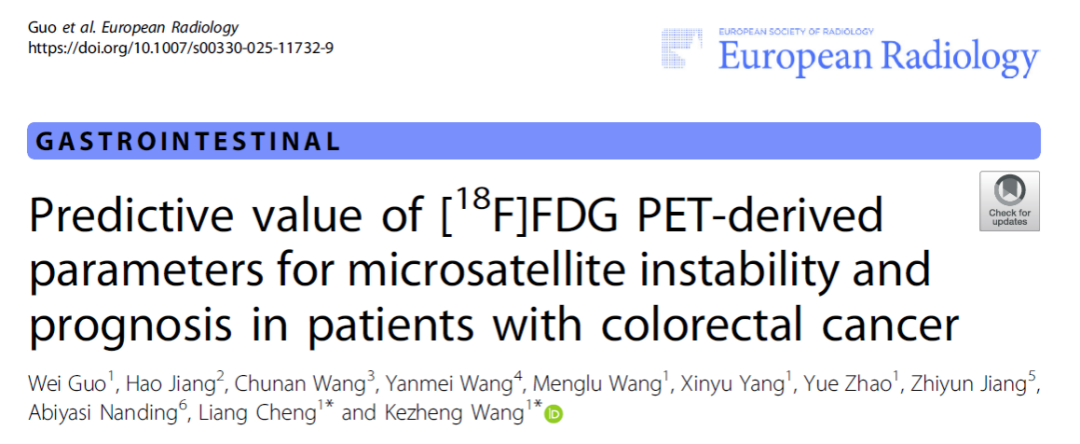
According to the latest statistics from the National Cancer Center in 2025, colorectal cancer (CRC) ranks second in incidence and fourth in mortality among malignant tumors in China. Many patients have already developed distant metastases at the time of diagnosis, losing the opportunity for surgery. Although immunotherapy, as another important treatment modality following chemotherapy, targeted therapy, and radiotherapy, has brought hope to some patients, the overall benefit population remains limited. Clinical practice has found that CRC patients with MSI-High (MSI-H) status in their lesions have a higher response rate to immunotherapy and significant clinical effects. This group accounts for approximately 15% of the total colorectal cancer population and is a key biomarker in prognosis assessment and treatment decision-making for colorectal cancer. However, traditional MSI detection methods, such as immunohistochemistry (IHC) for detecting MMR protein loss or polymerase chain reaction (MSI-PCR), have drawbacks such as long detection cycles and high costs, resulting in not all patients being able to receive timely testing.
To address this clinical challenge, Professor Wang Kezheng's team innovatively utilized 18F-FDG PET/CT clinical glucose metabolic molecular imaging technology, which can sensitively obtain both structural and functional information of primary lesions, distant metastases, and recurrent lesions in colorectal cancer patients through a single scan. Studies have confirmed that PET/CT metabolic parameters can non-invasively and accurately predict the MSI status of colorectal cancer, providing a brand-new non-invasive diagnostic tool for clinical treatment.
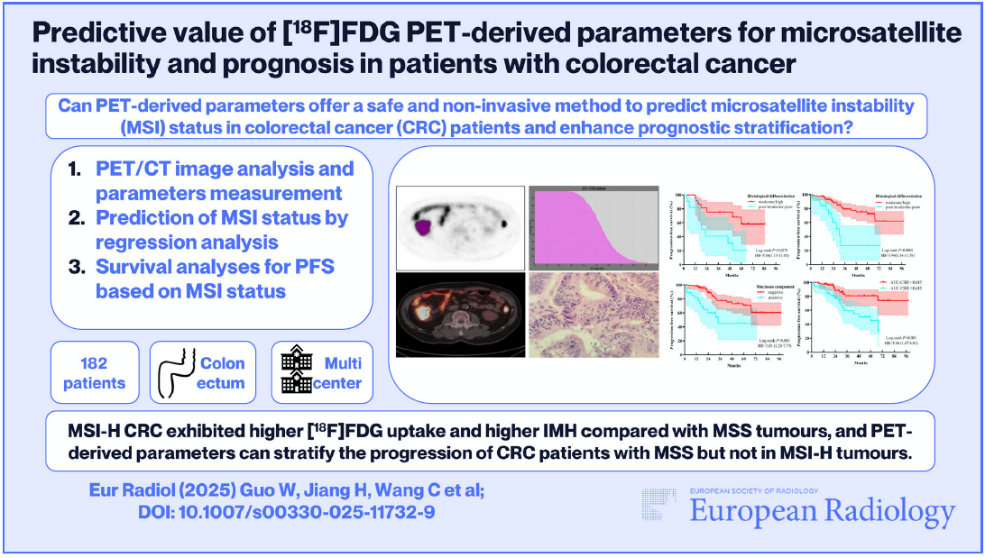
Through research, it was found that compared to MSS tumors, MSI-H exhibits higher glucose metabolic activity and intratumoral metabolic heterogeneity. PET/CT metabolic parameters can non-invasively predict the MSI status of colorectal cancer: metabolic tumor volume (MTV) and metabolic heterogeneity (IMH) are independent risk factors for predicting MSI status. In cases where sufficient tissue samples cannot be obtained, this method can serve as a supplement to traditional invasive testing, providing new options for tumor patients with insufficient tissue quantity.
Furthermore, the study established a prognostic prediction model based on MSI typing, which helps accurately identify high-risk patients and avoid overtreatment. For MSS tumors, metabolic heterogeneity, mucinous components, and poor differentiation are independent prognostic factors; PET parameters can effectively predict postoperative progression risk. In contrast, for MSI-H tumors, PET metabolic parameters show no significant correlation with prognosis, and only tumor differentiation can predict progression.
The publication of this research marks a significant breakthrough by the Clinical Molecular Imaging Research Team at Harbin Medical University Cancer Hospital's PET/CT-MR Center in the field of colorectal cancer diagnosis and treatment. With the widespread application and in-depth study of 18F-FDG PET/CT technology, it is expected to bring more precise and efficient diagnosis and treatment plans for CRC patients in the future, promoting the development of colorectal cancer diagnosis and treatment towards a more personalized and intelligent direction.
Research and development of novel dual-target PET tracer achieves significant breakthrough in precise tumor diagnosis
Recently, Professor Wang Kezheng's research team at the PET/CT-MR Center of Harbin Medical University Cancer Hospital has made significant scientific research progress. They have successfully developed a novel dual-target PET molecular tracer, 68Ga-pentixafor-c (RGDfK). This achievement has been published in the authoritative international journal "European Journal of Nuclear Medicine and Molecular Imaging" (a JCI and double-first-class journal in the Chinese Academy of Sciences classification), providing innovative technical means for precise tumor diagnosis.
In tumor diagnosis, precise lesion identification is crucial. G-protein coupled receptor (CXCR4) and tumor neovascular integrin (αvβ3) are highly expressed in various tumors and play important roles in promoting tumor cell proliferation, invasion, and metastasis. Due to the high heterogeneity of tumors, traditional single-target molecular probes have limitations in tumor diagnosis. This study focuses on CXCR4 and integrin αvβ3, two key targets, and significantly improves the sensitivity and specificity of tumor diagnosis through dual-targeted molecular probes.
The research team has demonstrated through rigorous preclinical and clinical evaluations that 68Ga-pentixafor-c (RGDfK) possesses excellent biosafety and clinical feasibility. In diagnosing primary and metastatic tumor lesions, its sensitivity, specificity, and accuracy are superior to those of conventionally used 18F-FDG PET/CT. For primary tumor lesion diagnosis, the sensitivity has increased from 74.7% to 93.1%, specificity from 62.5% to 79.2%, and accuracy from 72.1% to 90.1%. In metastatic tumor lesion diagnosis, sensitivity, specificity, and accuracy have improved from 74.5%, 78%, and 75.9% to 93.2%, 84.7%, and 89.7%, respectively.
Notably, when scanned 120 minutes after injection, the tumor-to-background ratio (TBR) of this tracer was significantly higher than that at 60 minutes. Especially when 18F-FDG PET/CT is difficult to determine the benign or malignant nature, 68Ga-pentixafor-c (RGDfK) demonstrates superior diagnostic performance, providing more reliable evidence for clinical decision-making.
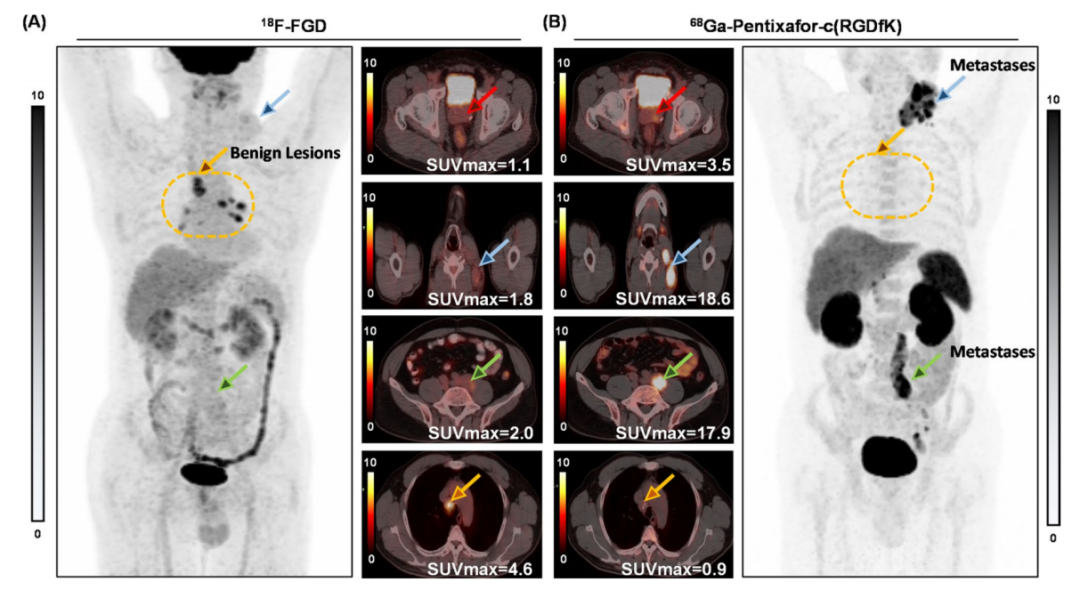
Figure (A) shows multiple enlarged lymph nodes throughout the patient's body, with no abnormal uptake observed on 18F-FDG PET/CT.
Figure (B) shows the precise identification of primary prostate malignancy and multiple abnormal radioactive uptake lymph node metastases by 68Ga-pentixafor-c (RGDfK)RGDfK PET/CT. Compared with 18F-FDG PET/CT, this novel tracer demonstrates no abnormal uptake in benign lesions (such as mediastinal and bilateral hilar lymph nodes), showing higher diagnostic efficacy for differential diagnosis.
As one of the first established PET/CT clinical molecular imaging centers in China, the PET/CT-MR Center at Harbin Medical University Cancer Hospital boasts strong research and development capabilities. It is among the first institutions in Northeast China to obtain the highest-level Class IV Radioactive Drug License. The center is currently equipped with two high-performance PET/CT systems, including an internationally leading five-dimensional holographic intelligent digital PET/CT. It conducts over 9,000 patient examinations annually, with a cumulative total of nearly 100,000 PET/CT examinations completed. Additionally, the center possesses two medical cyclotrons, multi-functional radiotracer synthesis equipment, dedicated FDG synthesis equipment, high-performance liquid chromatography (HPLC), gas chromatography (GC), and thin-layer chromatography (TLC) systems, enabling the research, synthesis, and diagnostic application of molecular probes labeled with various radionuclides including 18F, 68Ga, 11C, and 89Zr. Looking ahead, the center will continue to focus on international medical technology frontiers, steadily enhancing the professionalism and precision of clinical diagnostic services to provide higher-quality medical care for patients.
Source: Harbin Medical University Cancer Hospital或From: Harbin Medical University Cancer Hospital


Address:Ping An Fortune Center, Lize Financial Business District of Beijing