2025-10-27
The Cryogenic Underground Observatory for Rare Events (CUORE) has made significant progress, setting the most stringent limit to date on the half-life of 130Te neutrinoless double-beta decay at T0v1/2 > 3.5×1025 years (90% confidence level), with the results published in Science magazine.
The CUORE experiment is located at the Gran Sasso National Underground Laboratory (LNGS) in central Italy. The laboratory, affiliated with the Italian National Institute of Nuclear Physics, is one of the largest underground laboratories in the world. CUORE seeks to detect the rare physical process of "neutrinoless double-beta decay" by measuring extremely minute temperature fluctuations in crystals. If this process is confirmed, it would indicate that neutrinos are their own antiparticles, potentially providing crucial clues to the major mystery of why there is significantly more matter than antimatter in the universe - a question fundamental to human existence.
The CUORE core detector consists of 988 extremely high-purity TeO₂ crystals arranged in 19 crystal arrays, with a total weight of 741 kilograms. The collaboration has designed and constructed the world's largest cryostat, cooling TeO₂ crystals within a nearly 1 cubic meter volume to接近 absolute zero (<10 mK), forming an extremely sensitive calorimeter for rare event detection. The latest results released by CUORE are based on 2-ton·year (1 ton of crystal measured for 1 year) exposure data accumulated during nearly 5 years of stable data acquisition, representing the largest dataset published to date. The experiment has simultaneously employed new algorithms to effectively suppress background noise from environmental and equipment vibrations, achieving the most stringent limit to date on the half-life of 130Te nuclear neutrinoless double-beta decay: T0v1/2 > 3.5×1025 years (90% C.I.), corresponding to an effective Majorana neutrino mass of mββ < 70-250 meV, reaching international leading levels.
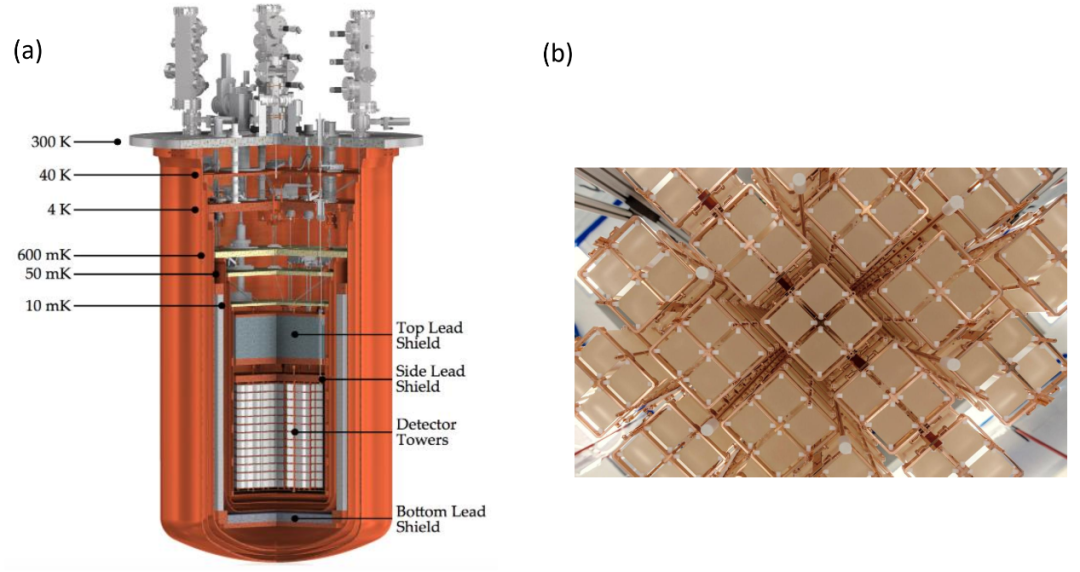 Figure 1: (a) Schematic diagram of the cryostat for the CUORE experiment (b) Detector composed of 19 crystal tower arrays (each tower array consists of 52 cubic crystal calorimeter units). Image credit: CUORE Collaboration
Academician Ma Yugang's team from the Institute of Modern Physics at Fudan University made significant contributions to the recently published research findings. The CUORE collaboration consists of over 100 scientists from Italy, the United States, China, Spain, France, and other countries. Since joining the CUORE collaboration in 2006, Academician Ma's team has been the first Chinese group to participate. They conducted high-precision radioactive background testing for early prototype detectors and subsequently participated in the on-site installation, commissioning, and over a decade of data acquisition for the CUORE-0 and CUORE experiments, laying a crucial foundation for CUORE's current large-scale experiment to achieve world-leading results. Dr. Fu Shihong, a 2024 graduate of the Department of Nuclear Science and Technology (co-supervised by Dr. Ma Long), served as a key contributor to this research, directly participating in data analysis and making significant contributions to noise reduction technology development and delayed coincidence background measurement.
Currently, the Modern Physics Institute at Fudan University is actively promoting the research and development of CUPID (CUORE Upgrade with Particle Identification), the upgraded version of CUORE. An experimental platform has been established based on the "13th Five-Year Plan" national major science and technology infrastructure of China Jinping Underground Laboratory. Led by Fudan University, the CUPID-China collaboration group was established through joint efforts with multiple institutions including Tsinghua University, Beijing Normal University, University of Science and Technology of China, and Shanghai Jiao Tong University. Together, they are developing a new generation of cryogenic calorimeter experimental technology based on 100Mo isotopes. Leveraging domestic advantages in crystal growth technology, they are adopting a new generation of optical-thermal dual-readout technology to develop molybdenum-based scintillation crystal detectors, with expected sensitivity significantly improved compared to CUORE. The advancement of this experiment will play an important role in promoting China's development in fundamental frontier research areas such as neutrino basic properties, matter-antimatter symmetry, and cosmic origins.
Source: Fudan University


Address:Ping An Fortune Center, Lize Financial Business District of Beijing