2026-07-10
On July 8, a high-end medical technology validation project designed to fill a regional gap was officially launched at the First Affiliated Hospital of Chongqing Medical University (hereinafter referred to as "the Hospital"). This marks the first clinical validation project in China for the Siemens Biograph Mission X PET/CT (Positron Emission Tomography/Computed Tomography).
On the same day, the "Theranostics Demonstration Center," jointly established by the Hospital, Siemens Healthineers, and Novartis, was officially unveiled. This milestone signifies that Chongqing has stepped onto a new level in the clinical research of high-end medical devices and the integrated application of precision diagnosis and treatment.
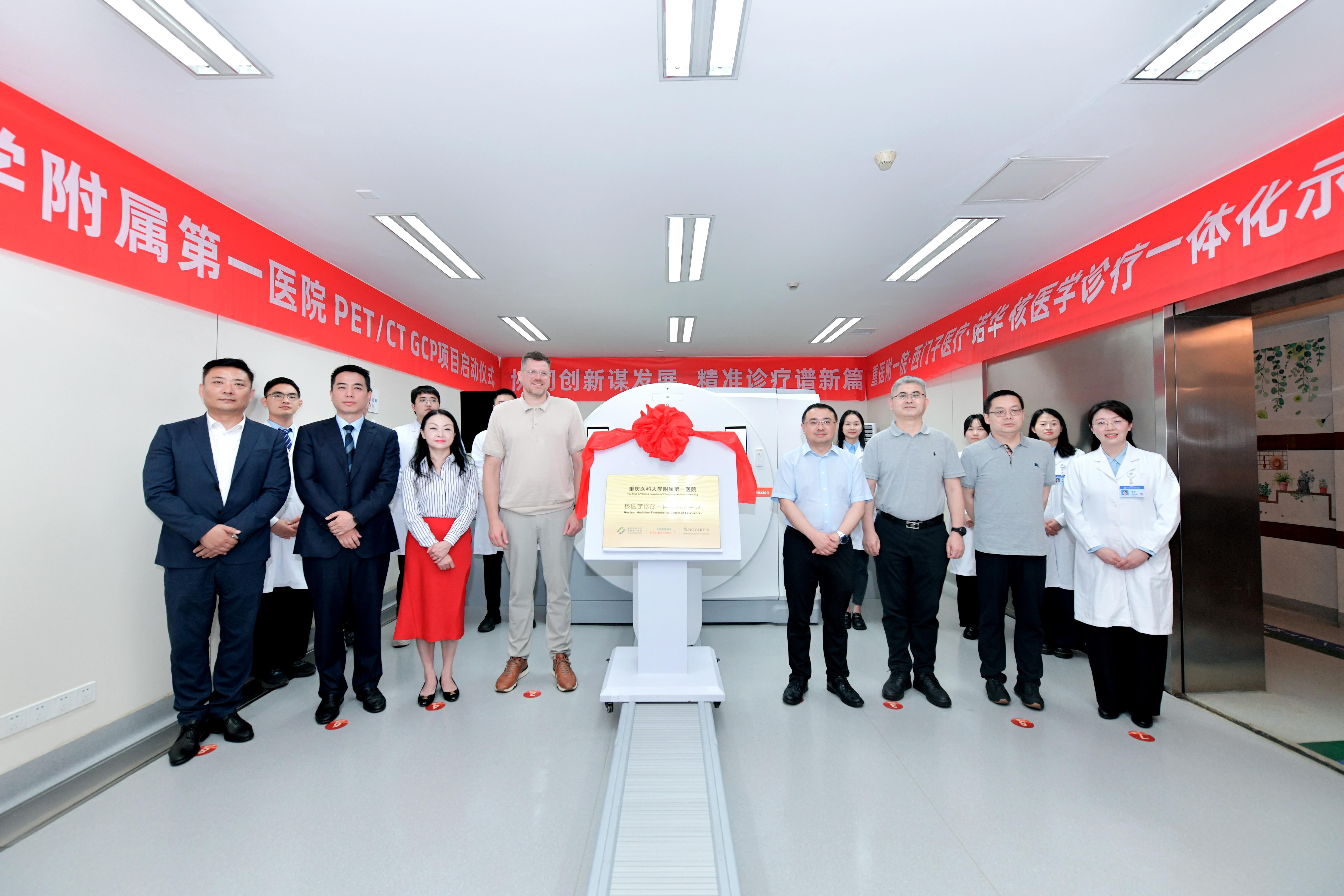
Photo of the project launch ceremony, courtesy of the First Affiliated Hospital of Chongqing Medical University
"This project is not only the first clinical validation for this specific equipment model nationwide, but it also makes the First Affiliated Hospital of Chongqing Medical University the first medical institution in Chongqing to conduct the validation of such cutting-edge equipment," said Professor Bai Dingqun, Vice President of the hospital.
He pointed out that medical devices must undergo rigorous clinical validation before they can be brought to market. Clinical research projects involving PET/CT validation units are highly scarce and carry significant academic value, thus placing high demands on a medical institution's clinical and research capabilities.
As a National Key Clinical Specialty, the hospital's Department of Nuclear Medicine serves as both the Chongqing Municipal Nuclear Medicine Quality Control Center and the Chongqing Municipal Nuclear Medicine Treatment Center, and holds the qualifications for Good Clinical Practice (GCP) in drug clinical trials.
PET/CT is widely hailed as the "crown jewel" of modern medical imaging technology.
Professor Pang Hua, Director of the hospital's Department of Nuclear Medicine and Deputy Director of the National Quality Control Center for Nuclear Medicine, introduced that the new short-axis PET/CT entering this clinical trial is suitable for the screening and diagnosis of various diseases, including tumors, neurological disorders, and cardiovascular diseases. The equipment integrates multiple cutting-edge technologies.
Over a rigorous one-year testing period, the image quality and application efficacy of the device in whole-body system scans will be scientifically evaluated. The clinical data generated will serve as direct, key evidence for the domestic registration and market approval of this equipment.
Professor Pang explained that the device's advanced features, such as AI-assisted diagnosis and precise quantitative analysis for cardiac and neurological conditions, will also be comprehensively tested during this validation. The ultimate goal is to establish an optimized standard for imaging workflows, driving nuclear medicine imaging to make a leap from merely "being able to see" to "measuring with precision."
Beyond equipment validation, the newly established Theranostics Demonstration Center will make patient care more convenient and efficient. Historically, patients diagnosed with malignant tumors such as prostate cancer often had to navigate between the Departments of Urology, Oncology, and Nuclear Medicine. Now, leveraging this demonstration center, patients can receive comprehensive, closed-loop management within a single platform, covering the entire process from precise diagnosis to targeted therapy, and ultimately, efficacy evaluation.
"Take metastatic castration-resistant prostate cancer as an example. Patients can now receive precise nuclear medicine imaging and targeted therapies using innovative radiopharmaceuticals, such as Lutetium-177 (Lu-177), all within the demonstration center," Professor Pang noted.
He pointed out that this "one-stop" service model not only significantly reduces the burden of travel for patients but also formulates personalized treatment plans through multidisciplinary team (MDT) collaboration, ensuring that cutting-edge medical technologies truly benefit the public. Currently, in addition to prostate cancer, this model will be gradually expanded to cover patients with neuroendocrine tumors and other advanced solid tumors.
Source: China Nuclear Technology Network


Address:Ping An Fortune Center, Lize Financial Business District of Beijing